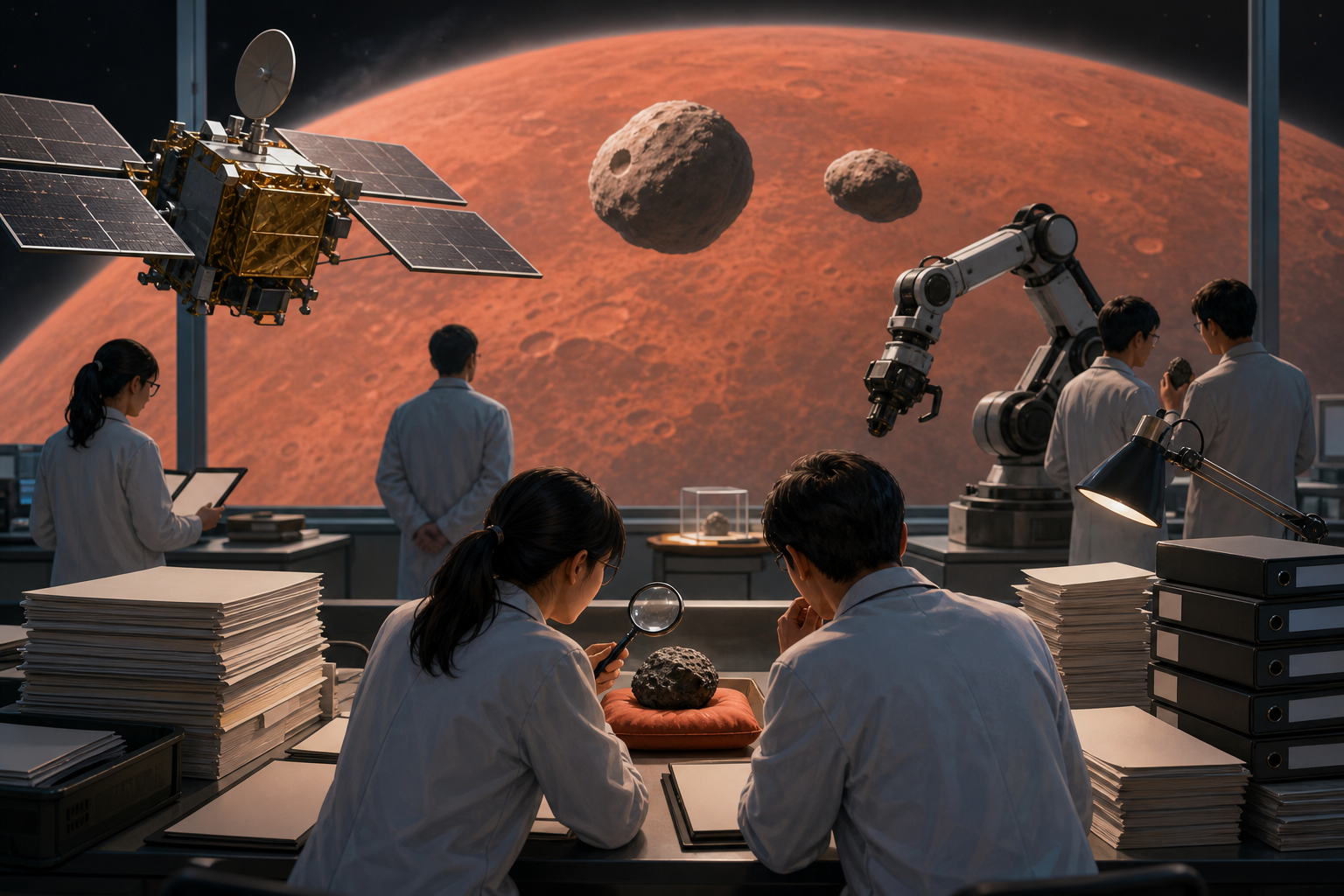
NASA is contributing to Japan’s Martian Moons eXploration mission, an effort led by JAXA to study Phobos and Deimos, determine how the two moons came to be, and return a sample. The collaboration places two relatively compact celestial bodies under a degree of procedural attention normally associated with a parking structure seeking historic designation.
At first, the task appears straightforward: characterize the moons, establish their origins, and bring material back for examination. But the mission’s more demanding purpose is expected to emerge once the sample is placed before an orderly sequence of laboratories, review panels, and specimen labels asking it to clarify whether it is ancient planetary debris, captured material, or simply a rock that has remained professionally noncommittal for an impressive length of time.
Phobos and Deimos have so far maintained the institutional advantage enjoyed by objects that orbit quietly and decline all requests for a biography. MMX will attempt to correct this imbalance by collecting evidence, comparing it with other evidence, and assigning the moons a more complete administrative identity than “small things near Mars.”
NASA’s role in the mission ensures that the inquiry will have the appropriate international character: one agency will help investigate the moons, another will lead the mission, and the moons will continue circling Mars without confirming receipt of the arrangement. If successful, the sample return may provide new insight into the origin of Phobos and Deimos, while also demonstrating that even distant rocks cannot remain unexplained once several space agencies have opened a file.
For now, the two moons remain where they have been, offering no public comment and making no visible effort to simplify the paperwork. The mission intends to take that personally, in the scientific sense.