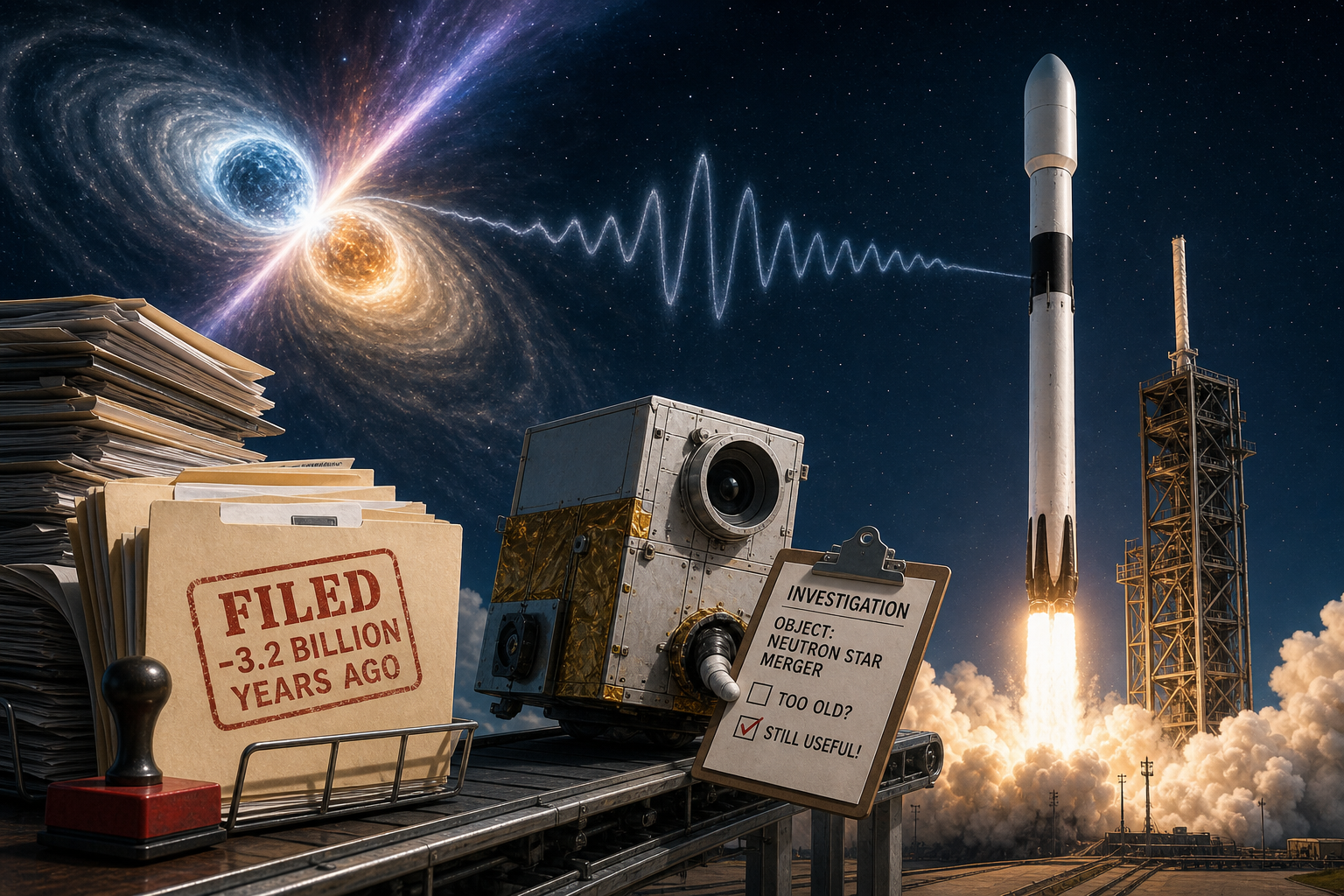
NASA has selected SpaceX to provide launch services for StarBurst, a small satellite mission intended to investigate neutron star mergers and the origins of short gamma-ray bursts. The mission is planned to fly on a Bandwagon rideshare mission aboard a Falcon 9 from Space Launch Complex 40 at Cape Canaveral Space Force Station in Florida.
StarBurst will study evidence from cosmic events that, by the time their signals arrive for examination, have already completed all immediate procedural obligations associated with exploding. The detector is expected to review the incoming radiation for indications that two neutron stars merged, emitted a short gamma-ray burst, and neglected to submit a forwarding address.
Under the proposed observational framework, the universe will be permitted to continue conducting catastrophic astrophysical events without prior coordination, provided it sends sufficiently clear gamma-ray documentation across the intervening distance. Researchers will then determine what occurred after receiving the relevant materials several billion years beyond any conventional filing deadline.
The rideshare arrangement will allow StarBurst to reach orbit alongside other payloads, an efficient approach that reflects the modern understanding that even fundamental questions about violent stellar collapse must share transportation. Once deployed, the satellite will begin monitoring ancient flashes with the measured professionalism of an office assigned to reconstruct an emergency from a faded fax.
NASA’s decision confirms that the agency remains committed to observing the universe as it was, rather than waiting for it to become more administratively current. Should StarBurst identify a useful signal, the findings may be entered into the record shortly after the responsible stars have ceased to exist.